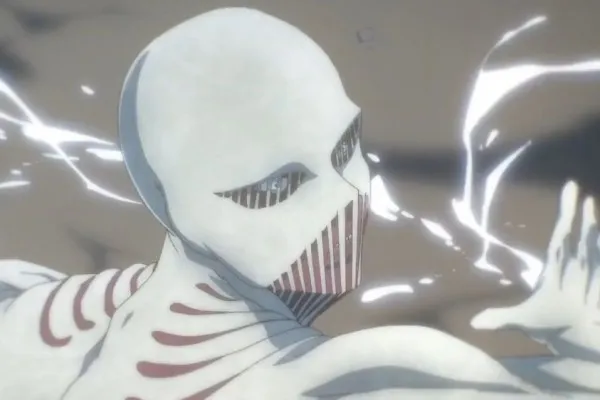
War Hammer Titan
Weapon construction, hardening, and remote control
A sculptor of hardened matter that turns the battlefield itself into an arsenal.
- Known holders
- Tybur family → Eren Yeager
- Signature
- Hardened weapons and structures
- Weakness
- Body can be linked underground
Story and role
The War Hammer Titan treats hardening as architecture. It can form spears, spikes, bows, and other structures from the ground, turning a flat battlefield into a field of traps and weapons. The form is associated with the Tybur family, a house that holds political influence in Marley by controlling the story of the Great Titan War. Its visual elegance hides a system designed to make power look ceremonial while it remains capable of killing at a distance.
Unlike most Titan shifters, the user does not have to sit inside the nape of the visible body. A hardened cable can connect the Titan to a crystalised human form underground, allowing the construct to keep fighting even when the apparent weak point is attacked. Eren discovers the limitation during the Liberio raid and wins only by forcing the power’s owner, Lara Tybur, into reach. The encounter turns the War Hammer’s creative freedom into a puzzle about where a person is actually located.
Eren later inherits the Titan, adding its construction ability to the Attack and Founding powers already moving through him. That inheritance is never presented as a simple upgrade. The War Hammer gives him more ways to shape the battlefield, but every new tool narrows the space in which other people can respond. Its body is a perfect image for the final season: a beautiful structure built from hardening, memory, and violence, with the human source hidden just beneath the ground.
The War Hammer’s creative range is governed by stamina, concentration, and the need to maintain a connection between the constructed body and the hidden user. A spear can control a line, a crossbow can open distance, and a hardened spike can turn the ground into an ambush, but each object is still part of a finite body. Lara Tybur’s remote method protects the user while making the cable a critical vulnerability. Eren wins by recognising that the visible Titan is not the whole combatant, a lesson that repeats throughout the series: spectacular power often depends on an unseen condition. Once he inherits the form, the imagery changes from ceremonial weapon-making to accelerated siege engineering. The ability lets him sculpt an answer to almost every attack, yet it also shows how quickly freedom can become a catalogue of available violence. The War Hammer is most memorable as a question about design: who gets to build the battlefield, and who is forced to stand inside it?