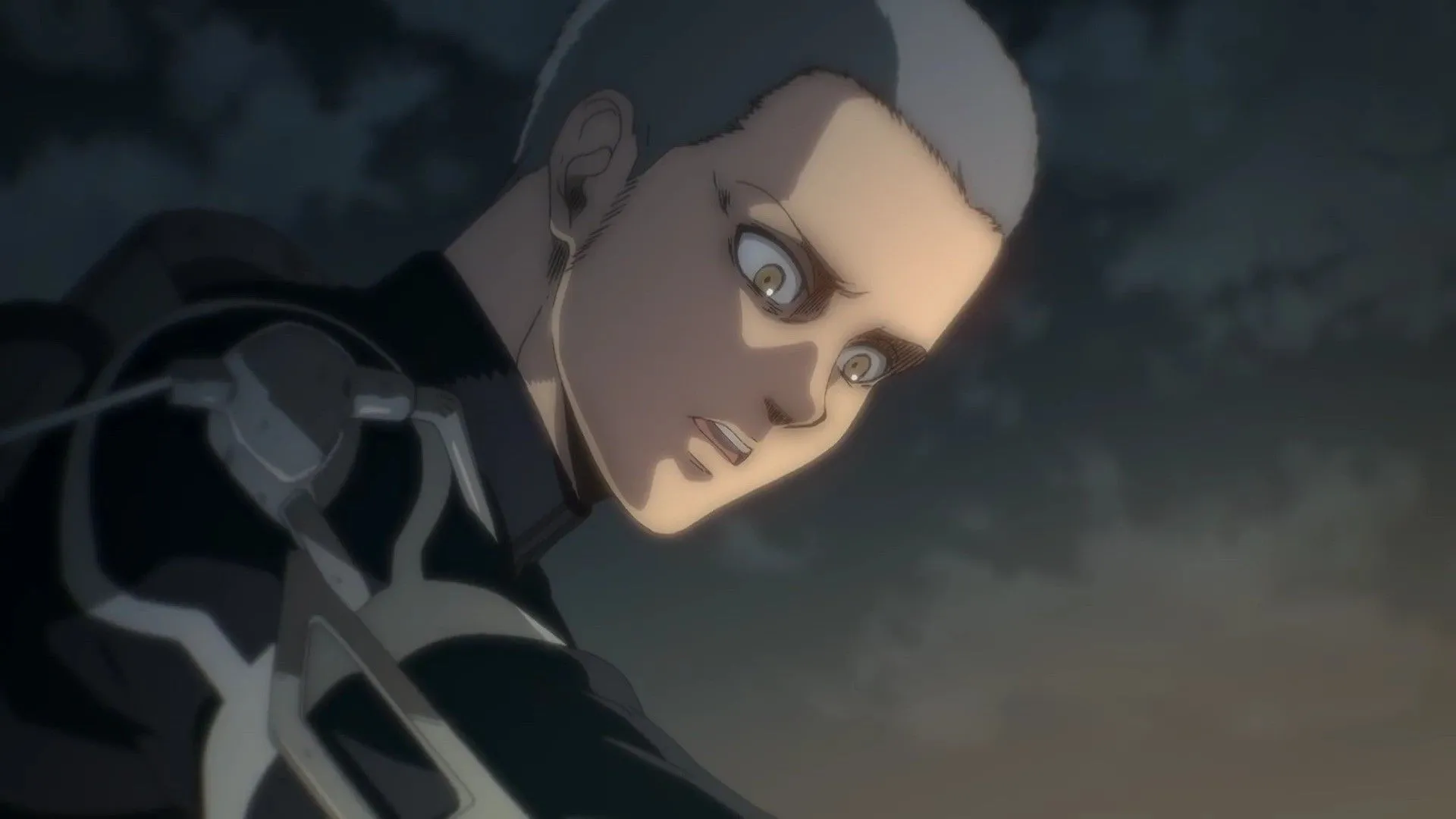
Connie Springer
104th cadet · Survey Corps
A quick-footed friend whose humour cannot keep grief from finding its way home.
- Origin
- Ragako Village
- Specialty
- ODM mobility
- Constant
- Sasha's closest friend
Story and role
Connie enters the story with the energy of someone who uses laughter to make a frightening room feel survivable. He is fast, expressive, and often the first to react, but the comedy never makes him disposable. His home in Ragako is one of the first places where the mystery of Titans becomes intimate. Finding the village empty, then realizing what happened to his mother, forces Connie to confront a horror that cannot be solved by a clean battlefield victory.
His friendship with Sasha gives the 104th a pulse outside its formal ranks. They share food, jokes, and the awkwardness of growing up inside a military institution. After the time skip, Connie is no longer simply the funny cadet. He carries the deaths of his friends and the knowledge that the enemy has faces that look like his own. His anger is often clumsy, especially when he turns it toward outsiders, but that clumsiness is part of the point: the war has reached people who were never given enough time to understand it.
When Connie considers sacrificing Falco to restore his mother, the story gives his grief a direct, painful shape. He wants one piece of his old life back, even if another child must disappear for it. Choosing to save Falco becomes one of his most important acts because it is not rewarded with a miracle. His mother remains a Titan until the final battle ends. Connie’s survival is therefore not a return to innocence; it is the decision to protect a future he may never get to enjoy.
Connie’s arc is also about the communities that form around loss. The 104th is not a perfect family, but it gives him people who remember the person he was before each new disaster. Sasha’s death leaves a specific absence in that group, while Armin and Jean help him move through anger without turning it into a permanent identity. His mother’s restoration at the end is emotionally powerful precisely because it does not undo Ragako. The village is still gone, and Connie cannot return to the childhood he expected. He can, however, speak to the person who survived the transformation and let her see the soldier he became. The moment condenses the series’ larger hope: survival is not the recovery of an old world, but the chance to meet someone again without hiding what the war has changed.
His humour gives the group a way to breathe, but it never cancels his intelligence or his grief. Connie notices when a friend is drifting, understands when a mission has changed its moral shape, and keeps showing up after the joke has stopped working. That persistence is its own kind of fieldcraft.